
Back to back publications on Cambrian and Ordovician Lagerstätte
We are excited to feature the lab's latest publications coming out a day apart from each other! First, graduate student Jared C. Richards led the first broad scale quantitive comparison between the conventional fossil biota preserved in the Early Ordovician Fezouata Shale biota of Morocco. The Open Access study published in Paleobiology takes a quantitative approach to test the empirical observations that the shelly components of the Fezouata Shale biota are typical for an Early Ordovician fauna, and that there are compositional differences between the older (Tremadocian) and younger (Floian) Fezouata Shale intervals with exceptional preservation. The answer is a resounding yes on both accounts! Using PBDB data Jared was able to demonstrate statistically significant differences between the Fezouata Shale horizons in the biodiversity of the conventional fossil assemblages, and that the Lower Fezouta Shale is typical for its age relative to similarly aged localities.

| This work is funded by NSF CAREER award (grant no. 2047192) "Ecological turnover at the dawn of the Great Ordovician Biodiversification Event—quantifying the Cambro-Ordovician transition through the lens of exceptional preservation". |

| 
|
Diversity of conventional fossils from the Early Ordovician Fezouata Shale biota of Morocco. | Quantitative comparison between the fossil biodiversity in the Lower and Upper Fezouata Shale relative to other Early Ordovician localities from high latitudes. |
Our second contribution comes as a result of our ongoing fieldwork and collections-based research on the middle Cambrian (Drumian) Marjum Formation of Utah, with a beautifully illustrated study led by Rudy Lerosey-Aubril featuring the exceptional preservation of abundant material of two new species of benthic graptolites, Sphenoecium marjumensis and Tarnagraptus cupidus. The work is published in Papers in Palaeontology, and highlights the rarity of this type of material when contrasted with the abundance of Cambrian sites with Burgess Shale-type preservation around the world. The spectacular fossils show that Sphenoecium marjumensis has a dense bush-like habitus consisting of up to 80 individual tubes, whereas Tarnagraptus cupidus demonstrates the earliest evidence of monopodial growth in benthic graptolites, otherwise known from extant species such as Rhabodpleura. This work is part of a larger project that investigates the paleobiologial significance of the Marjum biota and its contributions to understanding the Cambrian Explosion, which is rapidly becoming solidified as the most diverse and abundant Cambrian deposit with exceptional preservation in the United States of America, and second for entire continent just behind the world-renowed Burgess Shale from Canada.

| Fieldwork on the Marjum Formation is generously supported by the Putnam Expedition Grant and the Museum of Comparative Zoology at Harvard University. |
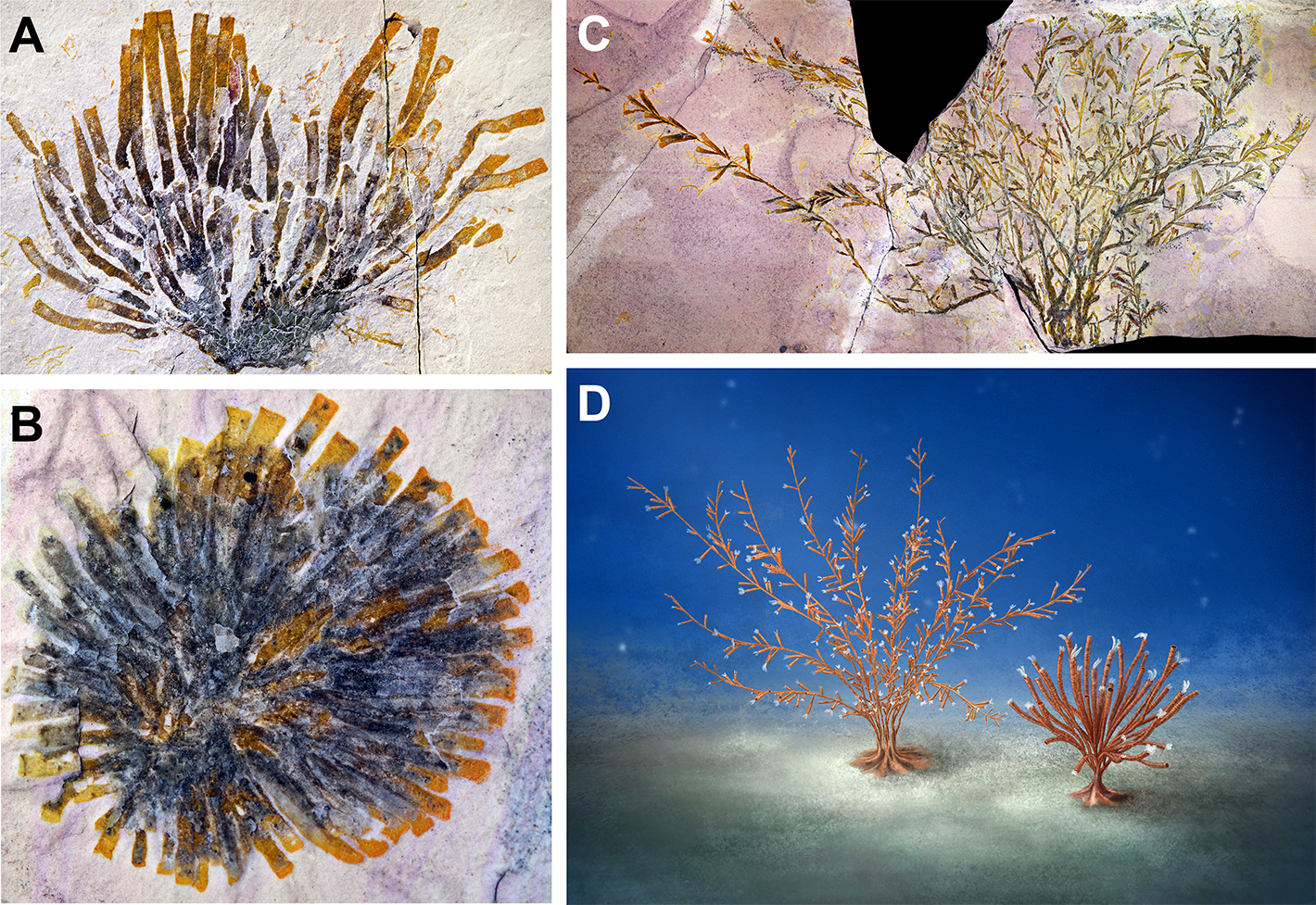
Diversity of benthic graptolites from the middle Cambrian (Drumian) Marjum Formation biota of Utah. Sphenoecium marjumensis (A, B), Tarnagraptus cupidus (C) and morphological reconstruction of Marjum graptolites (D) by Franz Anthony.